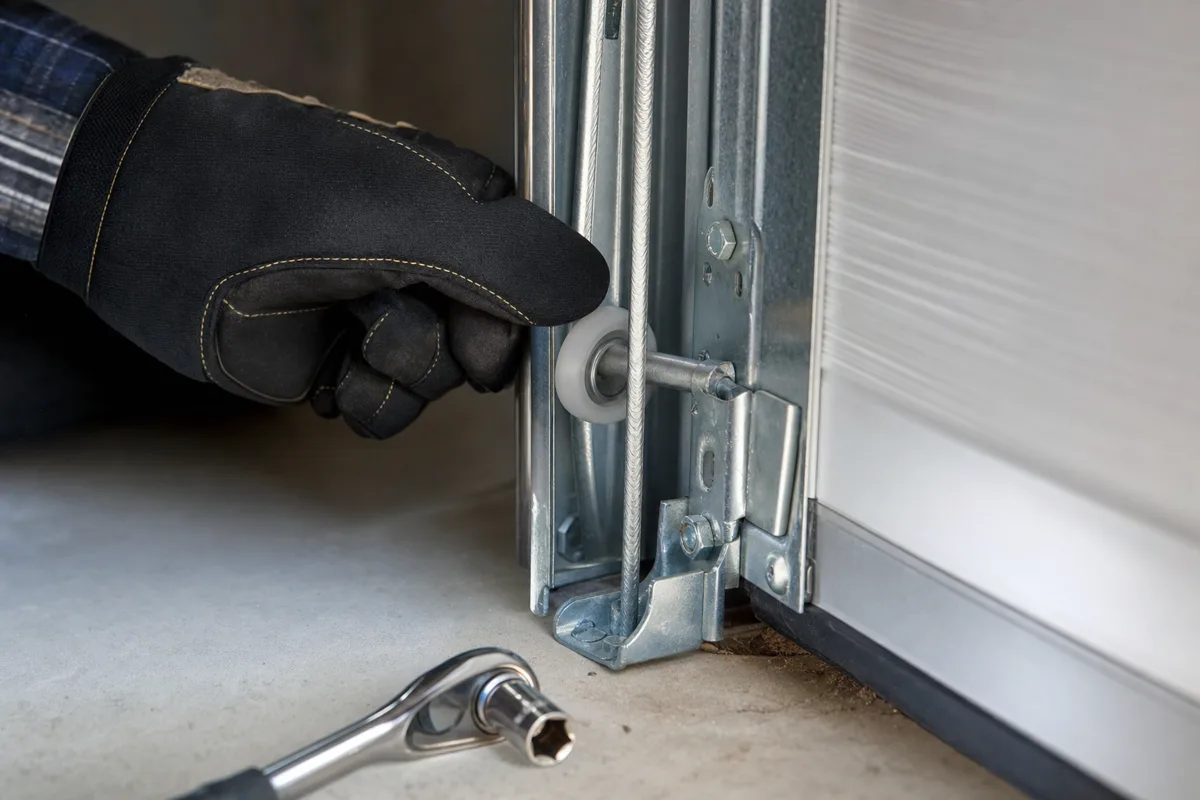

Garage Door Off Track Repair
Derailed doors supported, re-railed, and re-squared before they run again.
View serviceA roller outside the rail, a door hanging at an angle, or a cable that has gone slack is not a door to push back into place. Stop every command, stay out of the opening, and let the visible damage tell you what happened.
Stop the opener immediately. A crooked door, roller outside the track, cable off its drum, or bent rail needs a professional repair before any further movement. Do not re-seat the roller by hand or loosen track bolts. The repair must address the roller, track alignment, cable winding on the drum, and door balance as one system.
Tracks keep each roller on a precise path while the springs, drums, and cables share the door's weight. When a roller escapes, that relationship is no longer controlled. The cause may be an impact, a worn roller stem, a track that has moved out of alignment, a cable that has come off its drum, or a balance fault that pulled one side ahead. The visible problem is often a symptom, not the whole cause. Do not use the opener again, pull the emergency release, bend the rail, or push the panel. A partly raised door can shift suddenly and remaining rollers can be overloaded. Keep vehicles, people, and pets away from the opening. Observe from a distance and record its position for the repair request.
Start at the top. The early checks are the most common causes and need no tools.
Use no further controls. If the door is partly raised, stay well clear of the area beneath it and leave the emergency release alone. Keep vehicles, people, and pets away. From a distance, note whether the door is level or hanging lower on one side.
What it means: A tilted or partially open door should be treated as unstable and left untouched.
Look along the vertical and curved tracks without approaching moving parts. A roller may be outside the rail, a stem may be bent at the hinge, or the rail may have spread or pinched. Do not put hands inside the track, between sections, or behind a damaged panel.
What it means: A roller outside its guide confirms the door must remain out of service.
From a safe distance, compare the lower corners and look for a cable that has gone slack, crossed, or wound poorly on its drum. Drums guide cable winding as the torsion shaft turns; a cable that leaves its grooves can pull the door unevenly. Do not touch the cable, drum, shaft, spring, or lower bracket.
What it means: A slack or displaced cable means the lifting system has lost controlled alignment.
From several steps back, look for a fresh panel dent, an object in the travel line, a bent track section, or a roller that appears badly worn. A modest vehicle or storage impact can change track alignment enough for a roller to climb out later. Photograph the condition only if you can do so without entering the risk area.
What it means: Damage near the rail or panel may explain the escape, but the full system still needs repair.
Note whether the door is closed, caught in the vertical track, or stopped at the curve, and which side is lower. Include any preceding scrape, bang, or operator strain in the online booking form. Do not try a manual close or a second opener command; the position gives enough information for a safe repair.
What it means: The door's location and symptoms help identify track, roller, cable, and balance damage.
An off-track door can drop or swing because its guidance and load sharing are compromised. Do not use the emergency release, remove track bolts, force a roller into the rail, or bend the track with tools. Never handle torsion springs, cables under tension, drums, or lower brackets. A torsion spring stores enough energy to cause serious injury. Stay clear of the area beneath the door, do not park in the opening, and use the online booking form for track and cable repair.
For Bronte, Old Oakville, and Eastlake properties, lakefront moisture can contribute to rusty cable strands, seized rollers, and corroded hinges that may lead to an off-track door. Those conditions can add drag until a roller climbs an edge or a cable winds badly on its drum. If panel damage makes replacement more sensible than repair, a same-size door replacement does not need a Town building permit. Enlarging the opening does require one, and Oakville's bylaw also limits private garage-door width to 50% of lot frontage.
Derailed doors supported, re-railed, and re-squared before they run again.
View service
Worn rollers and damaged guides corrected for smooth, quiet door movement.
View service
Damaged lift cables renewed and aligned for level, reliable door travel.
View serviceFill out the form and we'll confirm your appointment by email.
These guides are written for Oakville homes. If the fix is beyond a homeowner check, we work everywhere inside this area.
Map data © Google. Pin shows the service area, not a walk-in location — all work is done at your home.

A real callout, not stock imagery.
A sectional door pulled off its tracks, taken down and supported on site so it could be checked and re-hung safely — photographed on the job.