
Garage Door Roller & Track Repair
Worn rollers and damaged guides corrected for smooth, quiet door movement.
View detailsDerailed doors supported, re-railed, and re-squared before they run again.

A door that has left its tracks is a different job from a door that binds or squeaks. Once a roller is outside the rail, the sections are no longer guided, and the weight the springs and cables were sharing is being carried by whatever is still attached: one cable, a hinge, a bracket, or the panel edges. Re-seating the roller is the last step of the repair rather than the first. The door has to be supported, the load taken off it in a controlled way, the cause identified, the cable winding reset on both drums, and the door re-squared in the opening before it is allowed to travel again.
Coming off the tracks does not mean the door is finished. Most derailments are repaired with new rollers, a section of rail, brackets, and a proper cable reset. Replacement enters the conversation when a section has folded around the operator arm, when a hinge mounting point has torn through the steel skin, when the shaft or a drum is damaged, or when the sections are bowed enough that they no longer seal against each other. Those are visible findings that can be shown and explained rather than assumed.
Work through the symptom first — some of these turn out to need no technician at all.
Reversing or parking contact against a vertical rail moves the guide out of line. The door may keep running for a while afterwards and then derail on a later cycle, which is why the contact and the failure often seem unrelated.
When one cable loses its wrap, that corner drops while the other side stays up. The door goes out of square within a single cycle and the rollers on the low side leave the rail.
Meltwater refreezing under the seal can bond the door to the floor. The next command lifts the top of the door while the bottom is held, which pulls rollers out and can bow a section.
A stem can break or a hinge can tear from the section it is fixed to. The wheel leaves the rail and the section follows, usually taking the neighbouring rollers with it.
Many of Oakville’s newer streets pair a wide double door with a short driveway, so vehicles manoeuvre close to the opening and contact with a vertical rail is a common way a door leaves its tracks. Glenorchy, Joshua Meadows, The Preserve, and the later Joshua Creek phases all see this. In the older detached garages around Kerr Village and West Oakville the more frequent trigger is winter, where meltwater refreezes under the bottom seal and bonds the door to the slab. Clearing slush and ice from the threshold during a freeze-thaw week takes a couple of minutes and prevents a much longer repair.
An off-track door has a broken load path, which means the weight is being held by parts that were never meant to hold it alone. Do not pull the emergency release, do not wedge or prop the door with stored objects, and do not send another opener command to see whether it will free itself. Each extra cycle can bend more rail, bow a section, or unwind a second cable. Keep vehicles, children, and pets out of the opening, leave the door where it is, and describe its position in the booking form.
The door is braced and clamped in its current position and the operator is disconnected from power, so no command can reach it while anyone is working near the opening.
Spring tension and cable winding are dealt with before any hardware comes apart. Removing a bracket or a roller from a loaded door is what turns an off-track door into a fallen one.
Rails, brackets, flag angles, rollers, hinges, the shaft, and the drums are checked. Creased steel is replaced rather than hammered back, because a hammered rail leaves a pinch point.
Rollers are returned to the rail, both drums are wound to matching tension, and the door is checked for level and for even spacing against both jambs.
The door is cycled by hand and then under power. Balance, travel limits, closing force, and the photo eyes are all confirmed before the door is put back into daily use.
Worn rollers and damaged guides corrected for smooth, quiet door movement.
View detailsDamaged lift cables renewed and aligned for level, reliable door travel.
View details
Damaged sections re-seated, re-anchored and reinforced — replaced only if needed.
View detailsFill out the form and we'll confirm your appointment by email.
Garage Door Off Track Repair is available across every Oakville neighbourhood inside the area below.
Map data © Google. Pin shows the service area, not a walk-in location — all work is done at your home.

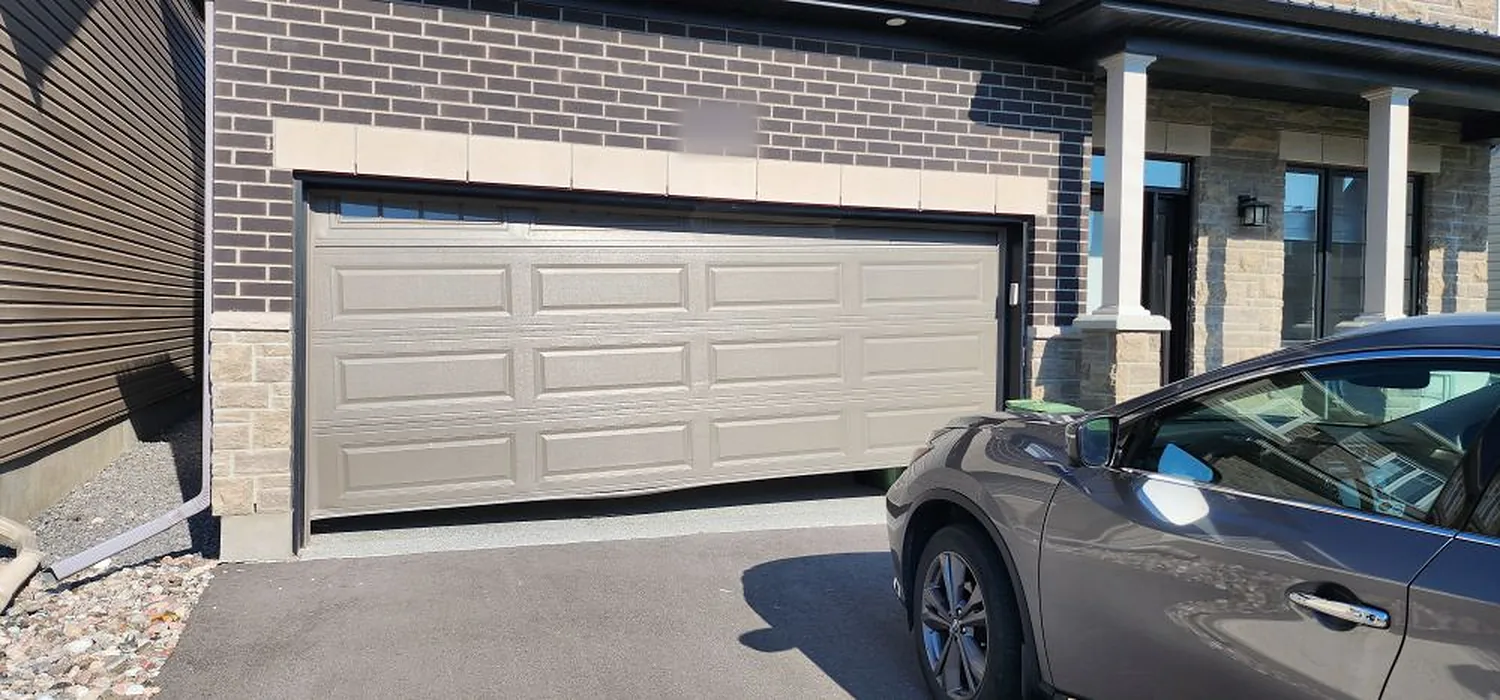
A real callout, not stock imagery.
A sectional door pulled off its tracks, taken down and supported on site so it could be checked and re-hung safely — photographed on the job.