
Garage Door Panel Repair
Damaged sections re-seated, re-anchored and reinforced — replaced only if needed.
View detailsMeasured, complete garage door systems selected for your opening and layout.

A new garage door should be selected from the opening outward, not from a catalogue image alone. Accurate width, height, side room, headroom, backroom, floor level, framing condition, and wind exposure determine what will fit and operate well. Door construction, insulation, panel design, windows, reinforcement, track arrangement, springs, and operator compatibility are specified as one system. The existing opening is measured on site because a door that is visually appealing but wrong for the structure can create sealing, clearance, and balance problems.
A complete replacement is most appropriate when the existing door cannot be matched, repaired, or kept structurally sound. Its useful life will depend on construction, exposure, cycle frequency, and maintenance of the springs, rollers, hinges, seals, and tracks. Selecting a door that fits the measured opening and maintaining the hardware gives the new system its best chance of smooth service.
Our troubleshooting guides walk the diagnostic checks in order so you can confirm the fault before booking.
Multiple weak panels, deteriorated stiles, failing insulation, and recurring hardware damage can make repeated repairs less sensible than a complete matched system.
An out-of-square frame, uneven floor, limited headroom, or inadequate side room affects weather sealing and track selection. These conditions must be measured, not assumed.
A homeowner may need insulation, windows, a different style, or a new opening arrangement. Structural changes create requirements beyond an ordinary door replacement.
Door width, frontage, heritage status, and permits can affect what can be built. These questions should be addressed before a new size or façade treatment is chosen.
Oakville permits a same-size replacement door without a Town building permit. Adding a new opening or making one larger requires a permit, with a minimum $200 fee where one is required. Zoning By-law 2009-189 also limits private garage door width to 50% of lot frontage. In the Trafalgar Road Heritage Conservation District, guidance places new garages and parking areas in unobtrusive rear or side yards. Confirm these points before designing an enlarged opening or a new detached garage.
New-door installation includes heavy sections, overhead tracks, and high-energy spring hardware. Torsion springs are under extreme tension and are not a DIY job. Never remove old spring or bottom-bracket hardware without controlling the door and counterbalance system. The installation should produce a door that is balanced by hand before an operator is asked to move it.
Opening width and height, side room, headroom, backroom, floor condition, jambs, and header are measured. The existing door and hardware are assessed for safe removal.
Panel construction, insulation, design, windows, track type, springs, weatherseal, reinforcement, and operator compatibility are selected together for the measured opening.
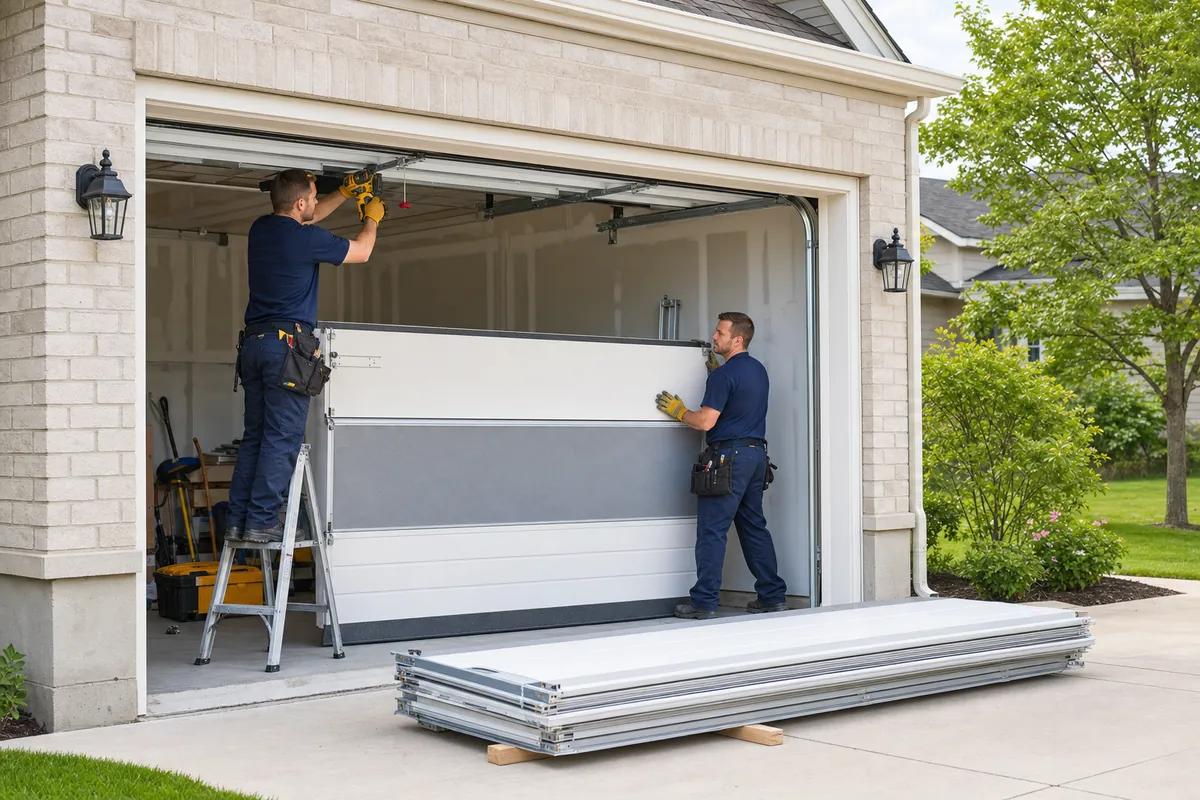
Old panels and lift hardware are removed under control. The new tracks, sections, springs, cables, and seals are installed in the opening and adjusted for level travel.
The finished door is tested manually through its travel, then with a compatible operator if present. Limits, reversal, and sealing are checked before normal use.
Damaged sections re-seated, re-anchored and reinforced — replaced only if needed.
View details
Compatible automatic operators fitted to balanced doors with tested safety systems.
View details
Preventive checks reduce friction, catch wear, and confirm safe daily operation.
View detailsFill out the form and we'll confirm your appointment by email.
New Garage Door Installation is available across every Oakville neighbourhood inside the area below.
Map data © Google. Pin shows the service area, not a walk-in location — all work is done at your home.

A real callout, not stock imagery.
A sectional door pulled off its tracks, taken down and supported on site so it could be checked and re-hung safely — photographed on the job.