
Garage Door Spring Replacement
Correctly matched replacement springs restore safe lifting after a spring failure.
View serviceYou may hear a sharp crack from the garage, then find that the opener only lifts a few centimetres or the door feels far heavier than it should. Those are classic signs that the counterbalance system has lost support.
A loud crack, a visible gap in a torsion coil, an opener that cannot lift the door, or a door that begins to rise unevenly can indicate a broken spring. Do not use the opener as a winch and do not pull the emergency release to test the weight. A torsion spring, cable, and drum assembly remains dangerous even after one spring has failed.
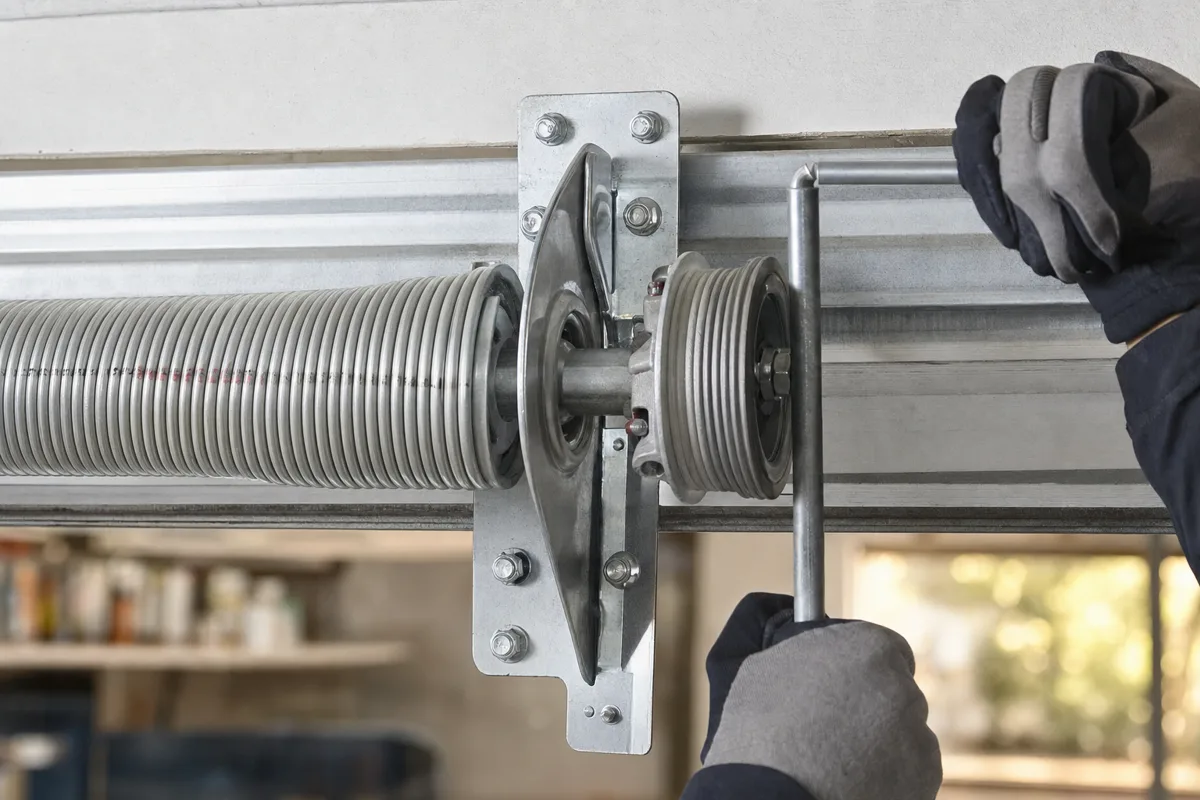
Springs do not lift the door on their own; they counterbalance its weight so the opener can guide a reasonably balanced door through the tracks. Each opening and closing cycle bends the spring steel. Every spring has a finite cycle life, and fatigue can accumulate without an obvious external warning. A torsion spring usually sits above the opening; extension springs run beside the horizontal tracks. When a spring fails, the door may remain shut but become too heavy for the opener, lift unevenly, or pull a cable out of proper tension. Do not prove the diagnosis by lifting the door yourself. Make at most one visual and operator observation with the door down, then stop. Spring work is controlled work for a professional, not a homeowner adjustment.
Start at the top. The early checks are the most common causes and need no tools.
With the door fully closed, stand back and look at the spring assembly above the opening. A torsion spring that has broken often shows a clear gap where the coil separated. Some doors use extension springs near the upper tracks instead. Observe only; do not touch the coils, cones, or shaft.
What it means: A visible gap in a torsion spring is direct evidence of spring failure.
Think back to the onset of the problem. A spring can break with a loud crack while the door is closed, so the only later symptom may be an opener that hums or barely lifts. Do not dismiss a sharp garage bang followed by a heavy door as a harmless noise.
What it means: A crack followed by lost lifting power strongly suggests a counterbalance failure.
If no test has already been made, command one brief opening cycle from a clear location. End it immediately if the door rises only slightly, the motor labours, or it reverses. The opener is designed to move a balanced door; it is not designed to carry the full weight after a spring fails.
What it means: An operator that cannot lift a normally working door may be missing spring assistance.
During that single observation, watch whether one lower corner moves first or a cable looks loose. A broken spring changes the load carried by the shaft, drums, and cables. Do not pull the emergency release, lift a corner, or try to wind a cable back onto a drum.
What it means: A tilted lift or slack cable means the door must stay out of service.
There is no safe benefit in checking the door's weight by hand. A failed spring can leave a large door unexpectedly heavy and poorly controlled. The visible coil, the sound, and the opener behaviour are enough to decide that professional service is required.
What it means: A suspected spring break is a stop-use condition, not a test of strength.
Do not replace, wind, unwind, cut, or handle a garage-door spring. Never loosen a winding-cone set screw, touch a cable under tension, move a drum, or remove a lower bracket. A torsion spring stores enough energy to cause serious injury. Keep the door down if possible, keep people away from the opening, and send an online booking request for spring service.
Glen Abbey was built largely in the 1980s, so original counterbalance hardware on an older door may be well beyond its expected cycle life if it has not already been renewed. Winter can expose that fatigue: January temperatures near −8.9 °C cause steel to contract and grease to thicken, while extreme cold has reached about −31 °C. Cold does not diagnose a spring break, but a spring that is already near the end of its cycles may fail on a severe morning. The response is the same in every season: stop operation and leave spring work alone.
Fill out the form and we'll confirm your appointment by email.
These guides are written for Oakville homes. If the fix is beyond a homeowner check, we work everywhere inside this area.
Map data © Google. Pin shows the service area, not a walk-in location — all work is done at your home.

A real callout, not stock imagery.
A sectional door pulled off its tracks, taken down and supported on site so it could be checked and re-hung safely — photographed on the job.