
Garage Door Spring Replacement
Correctly matched replacement springs restore safe lifting after a spring failure.
View detailsDamaged lift cables renewed and aligned for level, reliable door travel.

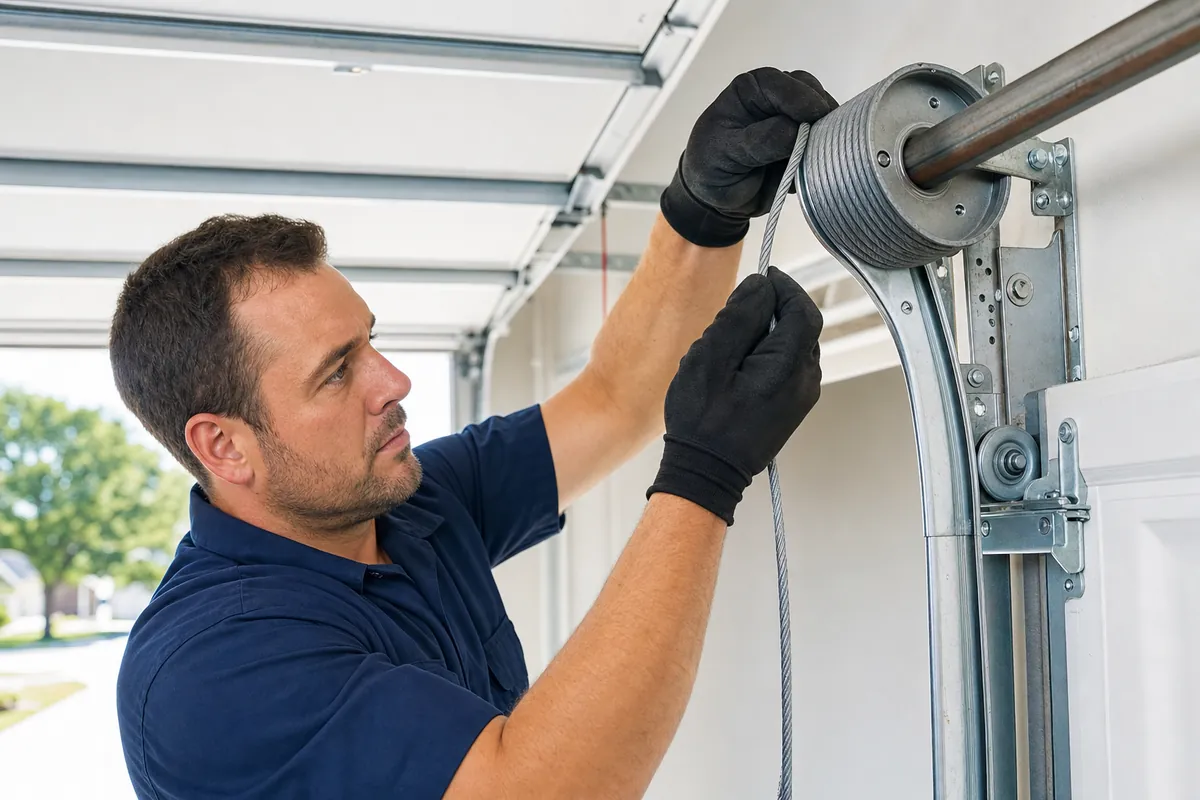
Lift cables carry the spring system's force from the drums to the bottom corners of the door. They must remain correctly seated, equal in length, and free of broken strands. A loose cable is often a symptom of another fault, such as a failed roller, crooked door, broken spring, or shifted track. Cable work therefore includes finding why it lost its path, not merely putting it back around the drum. Frayed or kinked cable should be renewed rather than reused.
Cable life depends on alignment, spring balance, door use, and exposure. Replacement is favoured when any strands are broken, the wire is kinked, or corrosion has roughened the cable. A cable that simply came off its drum may be usable only if it remains undamaged and the underlying cause has been corrected. Door sections do not need replacing solely because a cable needs service.
Work through the symptom first — some of these turn out to need no technician at all.
A broken spring or jammed roller can remove cable tension. Once slack develops, a drum can lose its winding pattern and the door can lift unevenly.
A loose vertical track or failed roller can pull the door away from its normal travel line. That shifts the lower bracket and changes how the cable approaches the drum.
Moisture, salt residue, abrasion, and repeated bending can break strands. A cable may look intact until the broken wires are found near a drum, bracket, or bend.
Cables need equal tension while the shaft, spring system, and door are held in a controlled position. Resetting one side casually can leave the door out of level.
On lake-facing streets in Bronte, Old Oakville, and Eastlake, wind-driven moisture can affect cable condition. Moisture settles where cable wraps around drums and where wire meets the lower hardware. Periodically look for rust staining, rough wire, or broken strands, especially near the floor where wet vehicles and road residue collect. A light coating does not prove a cable is unsafe, but broken strands do.
A lift cable is part of a loaded counterbalance system. Do not grab a loose cable, remove a bottom bracket, or try to wind wire onto a drum with the spring tension present. Bottom fixtures are connected directly to the lift load and can move violently. Keep clear of a door that is hanging unevenly and use the online form for an assessment.
The door is secured before the cable path is handled. Springs, drums, shafts, bottom brackets, rollers, and tracks are inspected for the condition that created slack or damage.
A frayed, flattened, or kinked cable is replaced with a correctly sized lift cable. Reusing damaged wire risks a second failure under load.
The drums and cable paths are set with consistent tension on both sides while the counterbalance system is controlled. The door must rise level from the floor.
The door is moved through its full travel to confirm the cable stays in its drum grooves and rollers remain guided. The operator is tested after manual travel is correct.
Correctly matched replacement springs restore safe lifting after a spring failure.
View details
Worn rollers and damaged guides corrected for smooth, quiet door movement.
View details
Preventive checks reduce friction, catch wear, and confirm safe daily operation.
View detailsFill out the form and we'll confirm your appointment by email.
Garage Door Cable Repair is available across every Oakville neighbourhood inside the area below.
Map data © Google. Pin shows the service area, not a walk-in location — all work is done at your home.

A real callout, not stock imagery.
A sectional door pulled off its tracks, taken down and supported on site so it could be checked and re-hung safely — photographed on the job.