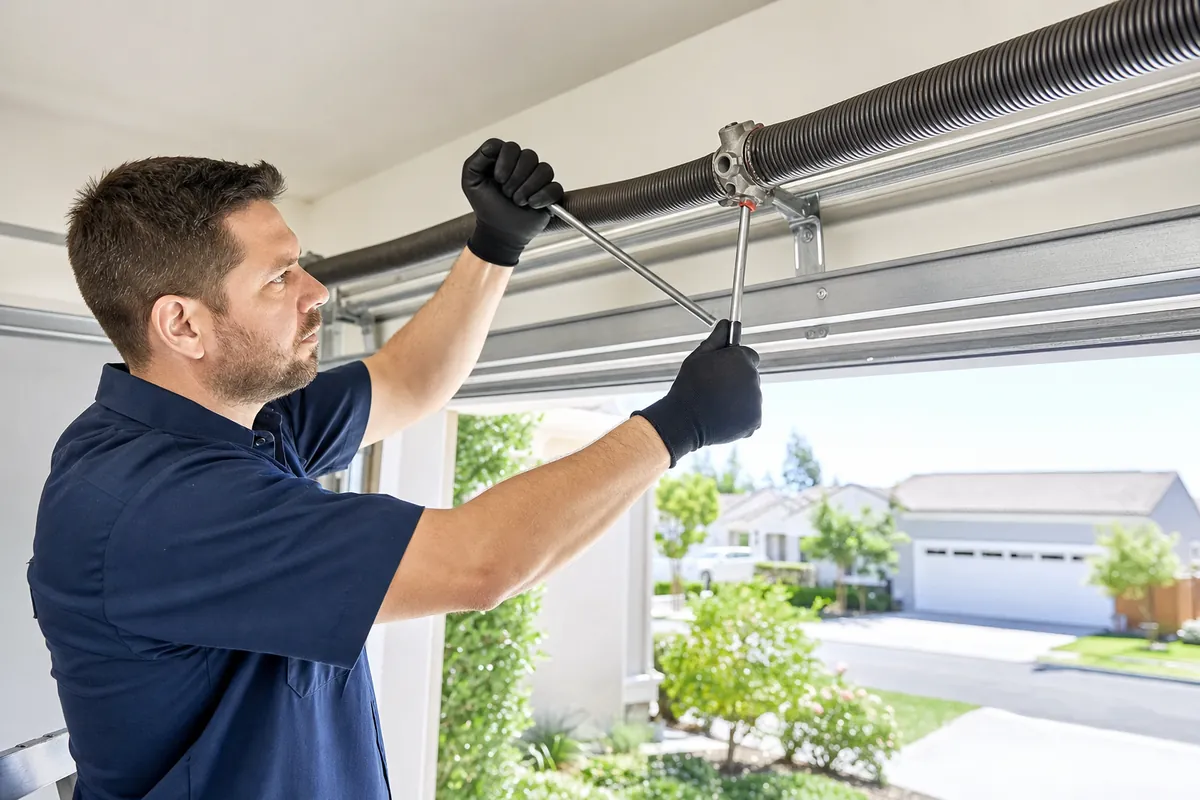

Garage Door Spring Replacement
Correctly matched replacement springs restore safe lifting after a spring failure.
View detailsPrecise counterbalance adjustments for intact springs and unevenly lifting doors.

A correctly adjusted spring system makes a closed garage door feel much lighter and lets it stay near mid-travel without racing up or dropping. Spring repair is appropriate when the springs are still intact and suited to the door, but the counterbalance needs correction after cable work, hardware changes, or a balance problem. It is not a substitute for a fractured, heavily corroded, or wrong-sized spring. The door, shaft, drums, and cable seating all need to be checked because spring tension is only one part of even lifting.
Springs are counted in opening-and-closing cycles, not fixed calendar years. Adjustment can restore a sound spring system after an identifiable change, but it does not renew metal fatigue or corrosion. Replacement is the better choice when coils are cracked, gaps appear in a torsion spring, wire is visibly degraded, or the installed spring cannot balance the door within a safe setting.
Our troubleshooting guides walk the diagnostic checks in order so you can confirm the fault before booking.
A door can lose balance after a cable has been reset, a panel has been changed, or the original spring setting has drifted from the door's current weight.
A spring that is too strong or too weak cannot be made ideal by adjustment alone. Wire size, inside diameter, coil length, and door weight must work as a matched system.
Uneven cable winding can imitate a spring problem. If one cable leaves the drum differently, the door can lift crooked even when spring torque is present.
Dry bearings, damaged rollers, a tight track, or binding hinges add resistance. Adding spring force to overcome friction can hide the true fault and make the door unsafe.
Oakville-area January nights commonly reach a mean daily low near −8.9 °C. Steel contracts in cold weather, and a spring already near the end of its cycle life may fail as the door is first used on a cold morning. Cold also thickens unsuitable grease at rollers and bearings, which can make a balance concern feel worse. A proper check distinguishes extra friction from lost counterbalance.
Torsion springs hold extreme stored energy. Their winding cones, bars, shaft, drums, and lift cables can move without warning if a set screw slips or the spring is mishandled. Do not attempt to add or remove tension yourself, and never use improvised bars. A broken spring is replacement work, not an adjustment.
The door is checked with the opener disconnected and under control. Its weight, midpoint behaviour, cable tension, and level movement show whether adjustment is appropriate.
The spring dimensions, shaft, bearing plates, drums, and cables are examined for damage and correct fit. A sound spring cannot compensate for a compromised support component.
Where the components are suitable, tension is adjusted with the proper tools while the door is secured. The goal is neutral, even movement, not a door that shoots upward.
The door is cycled by hand and then with the operator. Cable tracking, floor contact, opener force, and safety reversal are checked after the balance is corrected.
Correctly matched replacement springs restore safe lifting after a spring failure.
View details
Damaged lift cables renewed and aligned for level, reliable door travel.
View details
Preventive checks reduce friction, catch wear, and confirm safe daily operation.
View detailsFill out the form and we'll confirm your appointment by email.
Garage Door Spring Repair is available across every Oakville neighbourhood inside the area below.
Map data © Google. Pin shows the service area, not a walk-in location — all work is done at your home.

A real callout, not stock imagery.
A sectional door pulled off its tracks, taken down and supported on site so it could be checked and re-hung safely — photographed on the job.